If you have been paying attention to U.S. society over the last fifteen years, you will have noticed that the U.S. media and U.S. politicians believe we have a transgender ‘problem’. Studies of major news outlets (e.g., Pew Research Center, Media Matters) show roughly a 400–600% increase in the volume of transgender‑related coverage from 2010 to 2023.
Again, if you have been paying attention, you will have noticed that over 90% of these media outlets’ reports have been about transgender women. However, the Williams Institute at UCLA on August 20, 2025, published a statistical study on the U.S. transgender population in which they noted that transgender men constitute 34.2% of the transgender population, while transgender women constitute only 32.7% of the transgender population. (The remaining 33.1% of the transgender population was comprised of non-binary individuals.) Given those numbers, one would expect that at least 50% of the media coverage would be given over to the ‘problem’ of transgender men in the United States, but it is not. In addition, many of the biggest political debates about transgender rights center on transgender women, specifically: safety issues of cis-gender girls and women, transgender women’s participation in women’s sports, and access to women’s bathrooms. The question may be asked: Why?
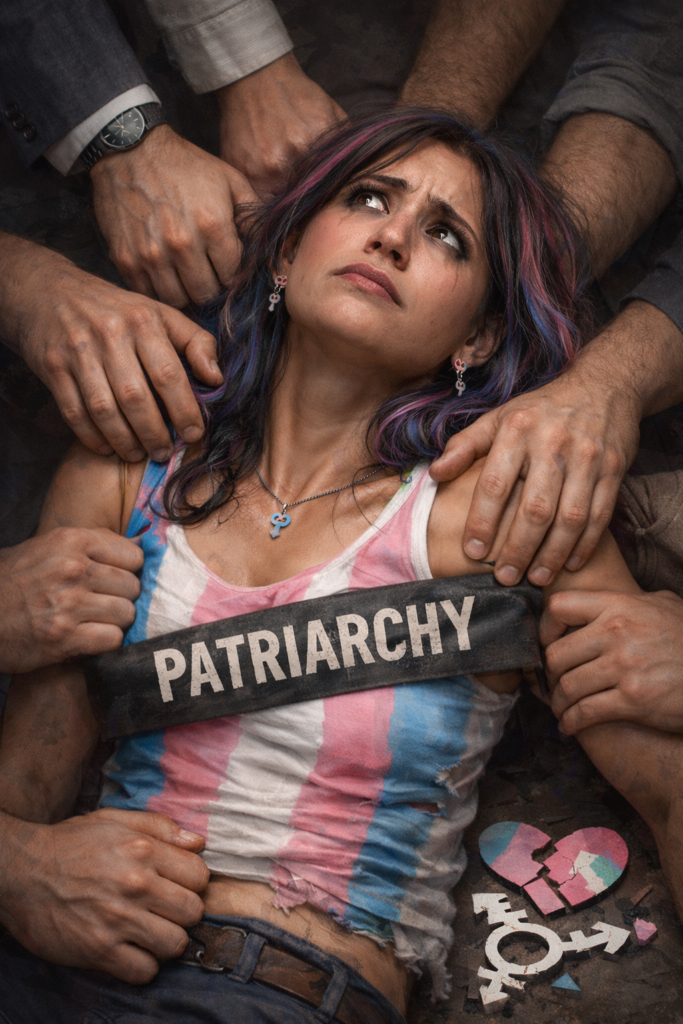
It is often easy to answer this question with one simple answer: patriarchy. But what does that really mean in this context of transgender women and men in media coverage and in the political arena? Why are transgender women considered a ‘problem’ to be analyzed and solved, while transgender men are largely ignored?
The Cambridge Dictionary defines patriarchy as a “society in which the oldest male is the leader of the family, or a society controlled by men in which they use their power to their own advantage”. In the United States, both parts of the definition applies. In many families in the U.S., men are considered the primary breadwinners, the leaders of their family, and often, the spiritual leader of the family. However, as the feminist movement gained traction over the last century, fewer families have followed this strictly patriarchal family structure. The United States, however, is still widely seen as patriarchal. For example, the U.S. has never had a woman president, the 119th Congress which began in January 2025 had only 26 women serving as Senators, but 74 men, and in the U.S. House of Representatives only 28% percent of the voting members were women. Additionally, the gender pay gap in the U.S. shows that women still only make 85% of what a man makes.
So how does the patriarchal society in the United States affect the transgender population, especially women? Since women have been and are still devalued in the U.S., masculinity and being male have a higher status in the U.S.’s social hierarchy. When someone assigned male at birth transitions to female, it challenges that hierarchy, especially in those who think gender is a choice or a mental illness. That change in hierarchy tends to trigger curiosity, controversy, and sometimes hostility. All of that interest sparks media outlets as they gravitate toward stories that generates strong reactions, ‘clicks’, and greater profit.
Women assigned at birth who transition to men are allowed much more leeway. U.S. society has always had much stricter rules and enforcement for masculine gender roles. Because of this, women have been allowed more freedom in their gender expectations: ‘tomboy’ girls, clothing choices for women that men cannot copy (e.g. pants vs skirts), and the use of makeup. Thus when a female assigned at birth transitions, few see that transition as a change in gender, just a change in expression. Once a transgender man gets past their male puberty, most trans men can ‘pass’. This is not often the case with transgender women. Thus, not only do trans women have a stricter set of rules applied to them at birth, their violation of masculine norms becomes more hyper-visible in society at large. Add to that transgender women tend not to ‘pass’ after going through male puberty without serious financial outlays and surgery. Thus, trans women are more visibly transgender in society than trans men.
Finally, many of the political debates occurring throughout the United States focus on transgender women alone. This, I believe, is patriarchy in its most insidious form. Recently, we have seen increased attacks on women’s rights in general. On June 24, 2022, the U.S. Supreme Court officially reversed Roe v. Wade, which allowed women the right to an abortion in all 50 states. Since the reversal of Roe v Wade, 13 states have enacted a total ban on abortion with few exceptions. In addition, the Trump administration has put a lot of focus on eliminating DEI (Diversity, Equality, and Inclusion). DEI efforts are meant to redress systematic inequities based on historical and current forms of racism, sexism, and other forms of discrimination. What this means is that any group that is not white, male, cis-gender, and often Christian, are viewed as ‘lesser’, and their successes are attributed not to their own intelligence, determination, and creativity, but to the powerful people giving them unfair advantages (DEI) at the expense of the white, cis-gender population who are seen as more deserving. As political discourse is becoming less inclusive to nearly everyone, i.e. more racist and sexist, it is no wonder that trans women get caught up in its wake. Not only are transgender women saying they are women, a lesser power state in the patriarchy, but they, too, are angry about the general loss of women’s rights. So trans women, like cis-gender women, fight the patriarchy in all its forms. But since transgender women are considered ‘new’ to society, and societally different than cis-gender men and cis-gender men, their activism seem outlandish and terrifying, and thus must be halted. (Personally, I have talked to quite a few cis-gender men that believe trans women are betraying men by choosing to be women and supporting feminism. They do not understand nor want to understand that gender is not a choice, and that feminism should be an inherent part of everyone’s identity, regardless of gender.)
Transgender women have been the primary focus for both media and politicians in the U.S. They are at the the forefront of fighting for transgender rights just by living their lives. For many of them, it is inescapable. So how to do we change this? The obvious answer, but the most difficult one to implement is to rid this country of its patriarchy. Truthfully, given this current administration and our country’s backsliding on women’s rights, I don’t see this happening any time soon. Men who succeed based on their maleness, do not want to give up their advantages and have to succeed only on their own merits. The same is true for many people who are white, cis-gender, and Christian. That extra help they get equates to a higher degrees of societal and job success.
So what other things can the trans population and its allies do to help trans women? One easy thing is call out media outlets that center transgender people, especially trans women in a negative light. Writing to these media outlets and threatening to cut subscriptions or viewership is a fantastic way to get media to pull back on their anti-trans articles. The more people who write to these media outlets, the greater the threat these media outlets see. Just as Jimmy Kimmel’s suspension proved, if enough people complain, media companies will back off for fear of losing viewership and thus, money. Once media outlets stop negatively reporting on transgender people and their work for equal rights, the less politicians will see it as a topic to rally around.
Politicians, too, need approval from the society in which they serve. Writing to politicians or calling politicians are other great ways to change the culture around transgender rights. If politicians receive many letters or calls stating that their constituency does not support their anti-transgender beliefs, politicians often change their minds. They need votes to get elected, and if people, through their letters and calls, threaten their outlook on being elected or re-elected, many will back-pedal on statements and laws that could jeopardize their election potential.
Transgender women are on the very cusp of the transgender movement for equal rights. Though not fair, our society centers transgender women as it argues who does and doesn’t deserve rights. Trans women, being more visible and seen as more deleterious to society for balking patriarchal norms, receive the brunt of medias’ and politicians’ vitriol. This vitriol is deleterious to trans women’s civil rights, mental health, and physical health. They need support and care. They need to be able to live a fulfilling life without fear. And that, we must support.
On a personal note, as a trans man, I think the trans community and its allies need to actively pursue protection for trans people, especially trans women. As more laws and stricter laws are passed every month in the United States, the trans community must show up to fight. Hiding, hoping that by going unnoticed we’ll retain our rights, has never worked – see the entire gay movement for proof. Civil rights and freedom of existence comes from being an active participant in the social and political landscape of the United States. Without action, I fear we are going to end up without rights and have to start from scratch to build up a foundation of people and institutions with whom we can launch another push for basic rights; rights, which we all had just a few years ago.
As Greta Thunberg said, “Activism works. So what I’m telling you to do now, is to act. Because no one is too small to make a difference.”
Leave a Reply